
The Intelligent Insurance Revolution: From Back-office to Customer Experience
The insurance sector has always been, at its core, a business of data management, risk assessment, and trust. In recent decades, digital transformation has been key in modernizing these companies at all levels, facilitating product access, streamlining processing, improving data cross-referencing, and optimizing the general efficiency of operations facing the new digital environment.
However, today we are witnessing a new paradigm shift: the arrival of Artificial Intelligence (AI) represents an even greater evolution, a technological force that will allow us to undertake a radical transformation in all areas of the business. AI is no longer a technology of the future or a pilot project; strategic reports from entities such as Gartner or McKinsey point out that the market value of this technology within the sector will reach tens of billions of dollars before the end of the decade. It is the differentiating factor that will mark the evolution of how policies are designed, sold, and managed.
For insurance companies, brokerages, loss adjusting firms, and repair networks, AI does not represent a threat of dehumanization. On the contrary: it is the ultimate tool to free professionals from the most monotonous tasks and allow them to focus on what truly matters: the customer. Below, we analyze how AI is impacting the entire insurance ecosystem through the lens of global trends and how ThinkUPC can be a key partner in turning this technology into a real competitive advantage.
1. Invisible Efficiency: Automation at the Heart of the Company
Before changing the way we interact with the customer, AI transforms internal work. Traditionally, insurance employees devote a very high percentage of their time to administrative tasks, reading complex contracts, sorting emails, and data entry. This is where generative AI and natural language processing make the difference.
Optimization of Office and Internal Processes
- Automatic Classification and Triage: Insurance inboxes receive thousands of emails daily from customers, suppliers, and mediators. Current AI systems are capable of reading, understanding the context, extracting key data (policy number, ID, type of claim), and routing the matter to the correct department immediately, attaching the previously analyzed documentation.
- Document Analysis: The review of reinsurance contracts, specific conditions, or legal regulations can be automated. AI extracts specific clauses in seconds, reducing management time from hours to just a few clicks.
In short: Fewer human errors, elimination of administrative bottlenecks, and a drastic reduction in waiting times and internal response times. The back-office becomes agile, lean, and extremely efficient.
2. Advanced Underwriting and Dynamic Pricing: From “Reacting” to “Preventing”
One of the most powerful trends identified in the sector is the evolution toward what is known as “active insurance”. AI allows companies to abandon the old static model of assessing risk once a year to move toward proactive monitoring and mitigation of it.
- Real-time Underwriting: By ingesting massive and unstructured data streams (data from IoT devices, home sensors, behavioral profiles, and automotive telematics), AI models calculate risk in a personalized and instantaneous way. This makes it possible to offer “pay-per-use” policies or on-demand coverages that are activated by hours or days.
- Proactive Risk Mitigation: Innovative insurers will use predictive AI cross-referenced with weather patterns and geographical data to anticipate natural disasters. This will allow alerting policyholders in a catastrophic area before the event occurs, reducing claims and saving lives. In the health line, algorithms will allow analyzing wellness trends to suggest early preventive interventions.
3. Redefining Customer Experience: Omnichannel and Synthetic Empathy
In a highly competitive market, user experience (UX) is the new battlefield. AI makes it possible to offer a service available 24 hours a day, 7 days a week, which is both instantaneous and deeply personalized.
Specialist Chatbots and Enrollment Assistants
Gone are the days of rigid decision trees. Latest-generation virtual assistants understand natural language and guide the customer through the contracting process. They analyze the needs stated in a fluid conversation, cross-reference the data with their risk profile, and recommend the ideal policy in real time and at any schedule.
Claims Processing and Empathetic Communications
The moment of truth in insurance is the claim. AI accelerates intake through voice agents that open files automatically from calls or emails, keeping the customer informed of the process status at all times.
In addition, generative AI is being used to draft tens of thousands of personalized daily communications. Studies show that resolution letters or claim status updates drafted with AI assistance turn out, paradoxalement, clearer and more empathetic for the customer than traditional corporate templates.
4. The Eye of AI: Automated Adjusting and Advanced Fraud Detection
It is not all chatbots and process automation. The capabilities of Artificial Intelligence applied to computer vision or image processing will also revolutionize the field of claims management, contributing to a drastic reduction in processing times.
Loss Adjusting Assistance with Image Recognition
In the event of a minor car dent or a minor incident at home, the insured uploads photographs themselves. The AI analyzes the images in seconds, identifies the affected parts, and generates a preliminary economic estimate of the damage. This facilitates the approval and payment of simple claims almost instantly, freeing human adjusters for truly complex cases.
Cybersecurity and Photographic Fraud Detection
Fraud consumes a significant part of the sector’s margins. With the rise of generative AI, creating fake images of accidents is extremely simple. Fortunately, advanced AI tools can act here as the perfect detective:
- Metadata and Pixel Analysis: They detect if a photo has been digitally manipulated, if the geolocation matches, or if the same image has already been used in another company.
- Inconsistencies in Reports: Cross-referencing adjustment or medical reports with historical data to identify “red flags” or insufficiently reasoned rulings that escape the human eye.
5. A Connected Ecosystem: Brokerages, Adjusters, and Repairers
The impact of Artificial Intelligence is not limited to large insurers, but contributes to optimizing use cases throughout the entire value chain. For example:
- Insurance Brokerages: They can use analytical AI to predict which users are at risk of churning and proactively offer them improvements before expiration.
- Loss Adjusting Companies: They can optimize their adjusters’ routes through geographic algorithms and speed up report writing with AI-structured voice dictation.
- Repair Companies: They will receive pre-qualified assignments with the necessary materials already identified by the insurer’s AI, accelerating repair times.
6. ThinkUPC: The Strategic Partner to Overcome “Pilot Hell”
Despite the enormous potential of AI, we frequently witness a very common phenomenon when starting its implementation: “pilot hell”. Many companies develop successful proofs of concept in controlled environments, but find themselves unable to scale them to real production due to overly ambitious approaches, rigid ecosystems, or data governance issues.
This is where ThinkUPC becomes the indispensable ally for companies in the field:
- Technical and Business Knowledge: Thanks to our experience, we master multiple areas of AI application and use that knowledge to develop solutions designed specifically for the operational reality of the sector.
- Integration Without Disruption and Technology Neutrality: ThinkUPC’s approach is based on technology neutrality. We do not sell a closed or constrained solution associated with a specific manufacturer; we carry out fully tailored projects that adapt natively to the customer’s existing technologies and infrastructure. In the design of each architecture, we place technological sovereignty, cost control, and data security and privacy (crucial in the face of EU regulations) as the key and non-negotiable factors to guarantee the long-term success and independence of the business.
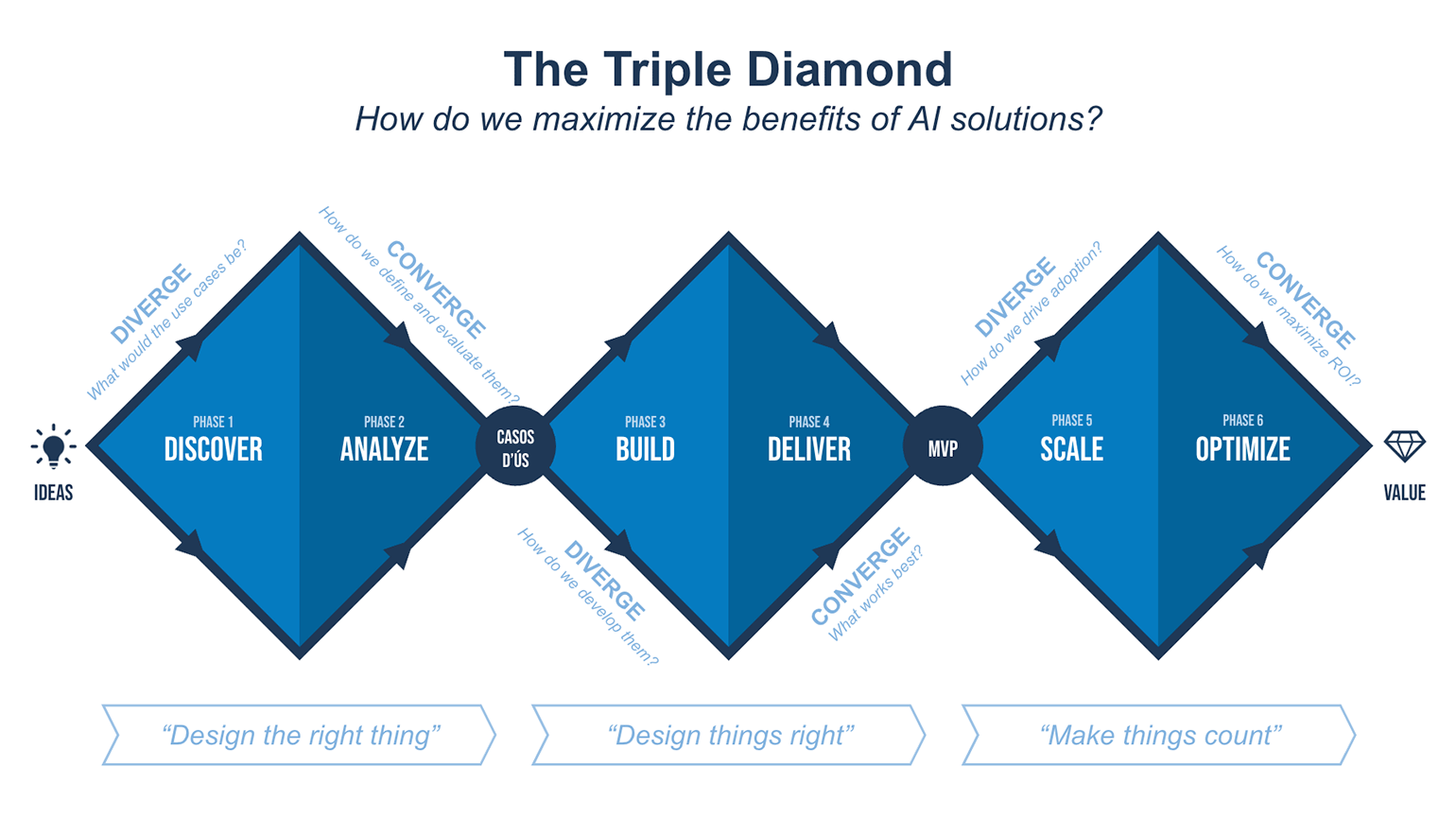
- Our Own Methodology for Identifying Use Cases: Our methodology based on the “triple diamond” allows us to help organizations detect the use cases where the application of AI is most attractive and, above all, to carry them out successfully by mapping a clear path that begins with the identification of high-impact use cases, their proper design and implementation connecting the necessary pieces, and, finally, the large-scale deployment of the intelligent solution.
Conclusion: Innovation to Compete and Lead
Artificial Intelligence has ceased to be an option for differentiation to become a survival requirement. Those companies and collaborators in the insurance sector that adopt these global trends early will achieve a drastic reduction in operating costs, streamline their responses, and provide impeccable service.
The transition toward AI presents complex challenges, but the neutrality, technical rigor, and strategic backing of ThinkUPC guarantee a successful adoption that will position your organization as a competitive benchmark in the market.